 |
|
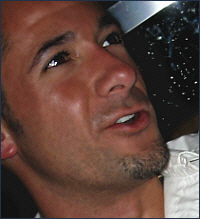
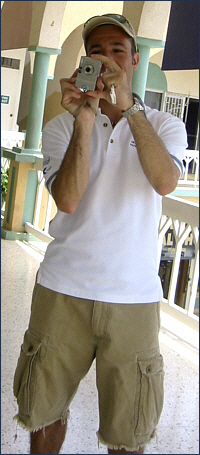
Hi! My name is Michael
Laca, I am a native South Floridian
and veteran hurricane chaser with over 30 years experience. A
fourth-generation Floridian, I was born in Miami, Florida and have lived in South Florida ever since.
My life-long fascination
with severe weather began after experiencing a severe
thunderstorm in central Florida in 1978. That summer I began using
my family's newly purchased VCR (back then called a VTR - Video Tape Recorder),
to videotape news reports and specials on hurricanes. The first
recording I made was of Tropical Storm Amelia's formation in
late July, 1978. One year later, in the summer of 1979,
Hurricane David devastated portions of the Caribbean before
turning northwest, skirting Miami, and making landfall near Palm
Beach, Florida. All the excitement and anticipation of that event cemented my love of severe weather,
particularly hurricanes.
Coming from a family with a
long history of hurricane experiences in Florida, I had always
heard stories from relatives who witnessed many of the Great Florida
hurricanes. Tales of the devastating storms that struck Key West
in 1919, Tampa in 1921,
Miami in 1926
and West Palm Beach in 1928 were always being shared. I can
vividly remember an aunt's first-hand account of a man mortally wounded by flying
debris in downtown West Palm Beach, as the second half of the
violent 1928 storm began. My family's experiences with tropical
weather continued with the numerous Florida hurricanes of the
1930's, 40's,
Hurricane King in
1950, and the back-to-back landfalls of
Hurricanes Donna
(1960), Cleo
(1964), Betsy
(1965), and Inez (1966). All of these stories and
experiences fueled a great desire to learn more about these
amazing storms and ultimately to experience them myself.
In August of 1980 a monster storm,
Hurricane
Allen, ravaged portions of the Caribbean and Texas and I was
glued to every advisory and news report. Unfortunately, for a
aspiring tropical meteorologist and storm-chaser, after Allen
the Atlantic-basin entered a relatively long-stretch of
inactivity. In the summer of 1981, a relatively weak Tropical Storm, Dennis,
crossed Cuba and made landfall in South Florida, producing
extensive flooding. Though minimal, Dennis is notable as the
first 'named' tropical system that I documented photographically. During the next two
years of inactivity, I passed the time honing my knowledge of
meteorology and tropical cyclones, reading virtually every piece
of literature I could find. I scoured libraries, bookstores and
universities for every text available... devouring titles
like: "Hurricanes" by I.R.Tannehill; "Atlantic Hurricanes" by
Dunn/Miller; and "The Hurricane and It's Impact" by
Simpson/Riehl.
By 1983, my fascination with hurricanes and tropical
meteorology had evolved into more of an obsession. I had begun
photographing every significant weather event that I
encountered... thunderstorms, high-winds, lightning,
flooding, etc... In the early summer, I spent some time with
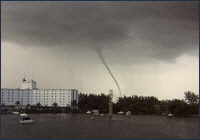
relatives in Key West and had my first significant waterspout
encounter. I photographed a beautiful tapered funnel that
developed just north of Key West and lasted for nearly 30
minutes. With the exhilaration I experienced, I knew that this
was something I wanted to do as much as possible. Later that
summer, Hurricane Alicia became the first hurricane since
Allen to strike the U.S., and I wanted desperately to go to
Galveston, Texas to experience it. Unfortunately, I had to settle for watching it on the news and
listening to advisories on NOAA weather radio.
During the fall of 1983, I started spending a lot of free time at the National Hurricane
Center (NHC)... which, at that time, was located in Coral Gables, Florida,
very close to my house. I made friends with several of the
employees there, including the director, Neil Frank. One of the
NHC historians, Alvin Samet, allowed me to go through the center's archived photos and purchase extra copies for
$2.50/each... needless to say, I probably funded an entire
ad-hoc research project with the amount of photos I purchased
that summer. In addition to the photos, the library at the NHC,
as well as at the Rosenstiel School of Marine and Atmospheric
Science (RSMAS) on Virginia Key, provided a wealth of historical
knowledge and books on tropical cyclones and their effects.
Then in early 1984 a
simple event became the first piece to the
puzzle that kick-started my chasing career. A local news stand, "Al's
News", started carrying the monthly periodical "Weatherwise".
While the publication had already been in existence for many years,
and I had seen old back-issues in the National Hurricane
Center's library, this was the first time that current
issues were carried in a
store that I frequented. I immediately picked up the latest
issue and was
overwhelmed, an entire magazine devoted to meteorology... with
numerous articles about severe weather and hurricanes!
In one of the first
"Weatherwise" issues I purchased, there was a classified ad from a professional
meteorologist, Steven Steinke, who was looking for other
meteorologists and weather enthusiasts to start a new monthly
periodical on meteorology, and to serve as authors for specific columns.
I wrote to Steven, providing some samples of my writing, and he paired
me with Marc Mailhot (a private meteorologist in Maine) to be
co-authors of the new publication's tropical column. The magazine
was incorporated as "The American Weather Observer" and Marc and
I were responsible for the "Tropical Topics"
section.
The second piece to the
puzzle came on my birthday in 1984 when my family, knowing my
love of severe weather and photography, gave me a brand new
VCR/Camcorder set. Finally, I was able to be mobile and shoot
video of every storm I came across... I think I filmed an
afternoon thunderstorm that very day. In September of 1984
Hurricane Diana formed just off the Northeast Florida coast.
Somehow, I convinced my mother to let me fly to Jacksonville and stay with
relatives, as
Diana was initially forecast to move onshore near there.
Unfortunately for me, Diana veered off to the north and
northeast, making a loop before finally striking North Carolina.
Though I didn't intercept the center, Diana is notable as the
first hurricane I truly 'chased'. Later that fall, I once again
went north to chase Tropical Storm Isidore. This time I
did intercept the center of the storm, however, Isidore was so
weak that it barely produced any significant weather at all.
But, it didn't matter, I was gaining valuable chasing
experience.
By late fall, I had written
several articles for the "American Weather Observer" and had
submitted my work to the prestigious American Meteorological
Society (AMS). In late 1984, at 16, I was granted an Associate
Membership to the AMS... at that time I was the youngest person
ever granted membership.
The third and final piece
of the puzzle came in December of 1984. Having read
"Weatherwise" for close to a year, I noticed in the
classifieds section that a couple of "storm-chasers" were offering
their videos for sale. One in particular, from Hurricane Diana
earlier that summer, caught my eye. Since I myself had chased
Diana and had missed its landfall in North Carolina, I
was extremely curious to see what it had been like. I ordered
the tape and within days received not only the tape, but also a
phone call from the storm chaser and videographer...
Jim Leonard.
I explained how I was obsessed with hurricanes and severe
weather and Jim explained that he was just as obsessed and had
been documenting hurricanes and tornadoes for several years. He
wanted to know if I was interested in seeing all the footage
he had and, needless to say, I invited him over immediately. The
day Jim came to my house for the first time, a rare December
hurricane was prowling the Atlantic northeast of Puerto Rico at
its peak, Hurricane Lili! So, with all of Jim's archived footage
and Hurricane Lili churning up the Atlantic, Jim and I
definitely had a lot to talk about.
Over the next several
months, Jim and I became good friends and by the summer of 1985 had made
plans to chase together. The hurricane season of 1985 didn't
disappoint and it wasn't long before Jim and I were headed out
to Key West to intercept the developing
Hurricane Elena. After
moving into the Gulf of Mexico, Elena's track became highly
erratic and Jim, Richard Pasch and I spent the next
three days criss-crossing the Gulf states from Louisiana to
Florida and back, finally intercepting Elena at landfall in
Biloxi, Mississippi. As a category three, with 120mph winds,
Elena was a personal milestone as the first major hurricane that
I intercepted, as well as having the most amazing eye passage I have
ever witnessed (to this day).
After Elena, and with
Jim's mentoring and guidance, my chasing career took off and
is still going strong today. This is a partial list of my
interceptions, to date (major hurricanes listed in
RED):
|
|
|
|
Hurricane
David (1979)
Tropical Storm Dennis (1981)
Hurricane Diana (1984)
Tropical Storm Isidore (1984)
Tropical Storm Bob (1985)
Hurricane
Elena (1985)
*
Hurricane Gloria (1985)
Hurricane
Kate (1985)
*
Hurricane Bonnie (1986)
Hurricane
Floyd (1987)
Hurricane Florence (1988)
Hurricane Gilbert (1988)
Hurricane
Hugo (1989)
Hurricane
Bob (1991) |
Hurricane Andrew (1992)
Hurricane
Emily (1993)
Tropical Storm Gordon (1994)
Hurricane
Erin (1995)
Hurricane
Opal (1995)
Hurricane
Fran (1996)
Hurricane Georges (1998)
Hurricane
Irene (1999)
Hurricane Frances (2004)
Hurricane Jeanne (2004)
Hurricane Katrina (2005)
Hurricane Rita (2005)
Hurricane
Wilma (2005)
Tropical Storm Ernesto (2006) |
Tropical Storm Barry (2007)
Tropical Storm Noel (2007)
Tropical Storm Fay (2008)
Hurricane Gustav (2008)
Hurricane Ike (2008)
Tropical Storm Bonnie (2010)
Hurricane Igor (2010)
Hurricane Irene (2011)
Hurricane Isaac (2012) *
Hurricane Matthew (2016)
Hurricane Irma (2017) |
* Intercepted multiple
times.
|
In addition to the
interceptions above, I have either directly, or indirectly, experienced
over 20 additional named tropical cyclones and countless other severe
weather events. During the last 25 years of my chasing career I
have been fortunate enough to have witnessed and documented some of the most
amazing and dramatic hurricane events in the Atlantic basin.
Most notably Hurricanes Hugo,
Opal, Andrew,
Katrina, Rita
and Wilma.
My photography and videography have been used worldwide in numerous text
books, magazines, advertisements, television programs, marketing
campaigns and other media including "Weatherwise", The
Smithsonian, National Geographic, The Discovery Channel, The Weather
Channel, The BBC, Duracell and others.
For the last nineteen years, I have maintained this website,
TROPMET.COM, dedicated to hurricanes, severe weather, storm
chasing and photography.
Over the last twenty years I have also worked as a Sr. Producer of
Interactive Systems for Royal Caribbean Cruises Ltd.
Aside from hurricane chasing, in my spare time I also enjoy
movies (especially horror and sci-fi), music, reading, fishing,
South Florida history, nature photography, video
games, comic books and animation. |